Sunday, April 8, 2018

Training your Pyr


Ralph
Barking

Pyrenees bark. If you’ve adopted from our rescue, it’s one of the traits we talk about in our adoption process. They are bred to guard, and take their job seriously. In fact, we frequently get Pyrenees surrendered into rescue for problem barking. It isn’t a lost cause, however, and with management and consistency it can be lessened, if not cured.  This is a behavior that requires a fair amount of effort on the human end of the leash! You are trying to change a behavior that is enjoyable and likely habitual for our dogs. As a human example, if you want me to change my morning coffee habit, which is both enjoyable and habitual, you would have to help me manage my behavior (take the coffee out of my house), give me an alternative (tea or a smoothie in the morning), and reward me for better decisions (set the money I save aside for a reward). It works the same way with our dogs.

Dogs bark for four main reasons. Start by deciding why your dog is barking and work from there. Remember that barking is a natural tendency for our dogs and we are working to help them modify a normal dog behavior.  It is also a behavior that is very satisfying for our dogs which makes it more difficult to change.


      Watchdog Barking - to alert that there is an intruder/change in the environment, and to let the intruder know they’ve been seen. Many people appreciate this alert barking from their dog, on a small scale. I want my dog to bark when someone approaches my door, but I don’t want her to bark every time someone walks by on the sidewalk. To address this, we want to be sure our dogs aren’t spending their time practicing the behavior when you’re not there to work on the training.
      Start with management. Try modifying the environment to help your dog be more successful. Don’t give them access to the window, yard, or area where they are watching, unless you are there to help monitor and train. Keep the curtains closed, or the dog crated/gated in a different room when you’re gone.  Don’t give them free access to the yard when you’re not home. In my house this meant moving the couch away from the front window so it didn’t become a perch from which to guard the neighborhood. If your dog gets to spend all day practicing barking, it’s not fair to be frustrated with them when you are home.
      teach a quiet cue. Say “quiet” or “that’s enough” once. If they stop immediately, reward them with a treat. If they continue barking, remove them from the situation for a quick time-out. (30 seconds to a minute) You will need to be really consistent. Don’t tell them the cue if you aren’t present to follow through. It’s not effective to yell  “quiet” from the porch while they’re barking in the yard, if you aren’t going to go and get them.

      Request Barking - seeking attention, food, to be let outside, let out of the crate…
      Ignore the barking and reward only when quiet. The rewards would initially have to come quickly when there’s a pause and build up to a longer quiet time. 
      Be prepared for an increase in barking initially (the extinction burst) because the dog is going to be frustrated that the request isn’t working anymore.
      Make sure to praise and pay attention to the dog when he’s quiet and doing what you want, not just when he’s barking for attention.


      Spooky Barking - the dog is afraid or uncomfortable.
      Slowly help the dog overcome his fear by helping him to associate treats/rewards with the presence of the scary noise or object.  (Every time the garbage truck shows up, treats fall from the sky).
      Try to avoid exposing the dog to the thing that is scaring him, unless you can work with him. The more he practices the barking behavior the worse it will get because he’s learned that the barking makes the feared thing go away, which is what he wants.
      This can be best prevented with a lot of socialization and exposure as a puppy. It’s more challenging to manage once the fear is established.

      Boredom Barking - barking excessively because they haven’t had their physical, social, mental needs met. This is probably some of the most common barking behavior we see.
      Increase physical exercise. Most dogs need two rounds of tongue hanging out level of exercise a day. A game of tug can be more tiring than a 3 mile walk!
       If they’re getting enough physical exercise, try increasing their mental exercise.  Have the dog work for their food using puzzle toys, learn tricks together, try a new training activity (manners, nose work)
      The dog might benefit from some play dates to burn off energy and increase social time. If the dog is being kept outside entirely or alone for long periods of time a dog walker or trip to daycare might help.

Another common barking behavior happens between dogs at a fence. This is frequently called barrier frustration. It might be frustration over being unable to get to the the other dog to play and be social, or to keep the other dog away from their territory. Either way, similar to watchdog barking, start with management. Don’t let your dog out at times you know the other dog is there. If you are going to have your dog in the yard, make sure you are with them to supervise. Have them drag a leash so they are more easily redirected. Consider planting a hedge against the fence as an additional barrier. For training, as soon as they notice the other dog, before there is a reaction, reward your dog for quiet behavior. If they head straight for the fence to start barking, immediately bring them inside for a short time out and start again. Try training a “leave it” cue, or train them to do something else when they get excited by the other dog - get a toy, run inside. It all comes with lots of rewards for appropriate behavior.
Natalie and Grace

One final note on barking and bark collars which are frequently sold in pet stores as a quick fix to the behavior. Pyrenees are  known to bark even with a bark collar on, sometime to the point of injury. Please find alternate ways to manage and train. If the barking is excessive, seek the help of a certified trainer to make everyone’s environment more enjoyable.

Natalie Wolf
Certified Professional Dog Trainer

Below are some videos of Pyrs barking if you would like to see different barking"styles".


Sunday, April 1, 2018

March Adoptions!

Zach and Zane
Happy Easter and what a beautiful morning!!  I thought I would share a photo of the first Pyr puppies that I fostered for GPRS - Zach and Zane with their cute bunny ears - and give a big THANK YOU to everyone on this beautiful morning for a WONDERFUL MARCH, with 35 adoptions!  

Several "long-timers" were also adopted this last month, making it extra special for Vida, Berg, and Pablo!   All of our fosters & volunteers make such a huge difference in the lives of these dogs, so we just want everyone to know how much we appreciate everything - big and small - that is done every day!

A BIG PYR-PAW of CONGRATULATIONS goes out to the following Pyrs for finding their forever homes in March:  Newton, Bailey, Sasha, Edgar, Pattison, Woodrow (S), Bling, Berg, Hugo, Oxford, Alicia, Carrie, Vida, Goldie, Milo, Paula Deen, Lily, Nadya, Gina (S), Norris, Nell, Chewy, Mickey, Barnie, Sammy, Jackie, Olinda, Bernie, Pablo, Ladybelle, Goober, Grace, Sonora (S), Little John, and Genevieve!

Juliette

Vida
Berg

Pablo

Friday, March 9, 2018

February Adoptions!

March is here and we are ready for spring!!  Here in Texas, we are having lots of rain and warm days.  The green grass is growing-and I am so excited to see the wildflowers blooming!!  We had a FANTASTIC February with 30 adoptions this last month!

We are SO THANKFUL to all our volunteers!  We had a lot of new screeners & fosters & online helpers that have been added in the last month or so-you are all so greatly appreciated and it makes a huge difference in the number of adoptions & lives saved!

Now for a big PYR PAW of CONGRATULATIONS to the following Pyrs that found their forever homes last month:  Marisole, Trudy, Nissa, Waly, Nanci, Maddox, Sweetie, Skylar, Brutus, Zeke, Tricia, Hank, Jane, Petunia, Nadeen, Anna, Leesa, Ophelia, TaraToo, Benjamin, Russell, Baby, Tim, Jonny, Lizette, China, Zola, Jaydon, Buck, and Einstein!

Juliette


Wednesday, February 21, 2018

Puppy Teaser!

Seriously, are any words really necessary at this point?  The "O" puppies!  Coming to the great Northwest soon!

Ottavia


Ocean and Olinda

Oxford and Odell

Tuesday, February 20, 2018

Meet and Greet

Don't forget!

This Sunday, February 25, 2018 from 11 am to 2 pm volunteers and rescue dogs will be at the Sellwood Pet Supply in Portland!   The address is 8334 SE 17th Ave, Portland, OR 97202

Talk to the volunteers about the Great Pyrenees breed, adopting, and volunteering!  We hope to see you there!


Thursday, February 15, 2018

Tips for New Adopters

So you're considering adopting a Great Pyrenees?  Great news!

Certainly if you are an experienced Pyr owner you probably familiar with this term:

ad-dic-tive/ǝ'diktiv/causing or likely to cause someone to become addicted to it.  

I've heard a saying recently, "Pyrs are like potato chips, you can't have just one".  Equally true, although you may have had one or even two Great Pyrenees dogs in your lifetime, chances are the next one will be completely different!   Their dog personalities can range from being goofy and playful to serious and stoic.   What is it about some of us who are completely devoted to this breed while some others folks relinquish their dogs into rescue due to Pyr characteristics they can't or won't embrace?  For me it's a deep understanding of this breed and being accepting of all their unique characteristics, but I would invite other readers to weigh in below in the comments.  It's true that Great Pyrenees as puppies are very difficult to resist...fluffy butted, sweet faces, with wondering eyes that watch their owners intently.

But these angelic beings grow up to be extremely intelligent adult dogs with an essential job to perform-guarding.  As some people get a negative picture in their head from the word "guard" it's utilized in this post as this:

guard/gärd/watch over in order to protect

What should one know prior to adopting a Great Pyrenees?

1.  Great Pyrenees are bred to be GUARDIAN DOGS.

Okay, let's unpack that as there are probably many perspectives about guard dogs depending on what type of dog you are used to- so what does that mean exactly?

I see that the American Kennel Club has changed their website so the first descriptions you see initially of the Great Pyrenees is "majestic,  Zen-like calm, and graceful".  Okay, sure, absolutely!  And typically Pyrs are instinctively guardians, meaning guarding is natural.  They are bonded to a herd (goats, sheep, chickens, cats, little people, big people, various things they see as a herd...). But the guarding...what does that look in behaviors?  Their mere presence is enough to ward off predators due to their barking and displaying very aggressive behavior.  While it's important to know the rescue adopts out dogs as companion dogs only, they still have the characteristics of livestock guarding dogs.


2.  Okay, so they have INSTINCTIVE GUARDING characteristics.  Instinct is nothing you can teach nor can you entirely remove it.  Great Pyrenees are one of the oldest of the livestock guarding breeds and they are bred to be independent thinkers (National Pyr Rescue website).  This means they don't need to consult with you for any decision they make.  I've described "training" a Great Pyrenees as being able to get them to do what I want and make them think it's their decision.  Luckily for me, Whitman would much rather choose to be in the house with a yummy treat versus barking out in the yard.  GPRS does have certified trainers who are experienced in training these dogs and they are an integral part of of this rescue and contributors to this blog.  To read about ideas of how to train your Pyr check here.


Monday, February 5, 2018

Training your Pyr

How to Train a Monster

Rufus aka "Monster"
"He had already been nicknamed "monster puppy" before he even arrived at my house.  7 months old and 80 pounds he was a puppy of monstrous proportion.  It was shortly after coming to me as a foster that I realized the name "Monster" might stick because he was also behaving like one.

I'm fairly sure I rolled my eyes during my conversation with his surrendering owner-mouthing, chewing, relentless play.  Our rescue had heard it all before.  Big, cute, fluffy Pyrenees puppy becomes adolescent and no one can be bothered anymore.  'Don't worry' I said.  'I'm a trainer, we'll be fine.'  You know what they say about Karma and how pride comes before the fall;  it was my first of many lessons in humility that Monster would teach me.  Within days of his arrival I was made keenly aware of my arrogance.

As a trainer, there are some things I do really well.  I know how to manage a situation and environment to help a dog be successful.  Consistency, routine, clear expectations, positive reinforcement, mental and physical exercise are my strengths.  And none of it was working.  On our walks he would get easily worried or overstimulated.  Grass was a trigger.  Try walking through a neighborhood avoiding grass!  For Monster, overstimulated meant running across the lawn, diving onto it head first, then turning around with a glimmer in his eye and flying at me, grabbing my arms and growling.  My only recourse was to drag him, still attached to my arms, to the nearest tree, wrap the leash around it, extract myself, step back and wait for him to calm down.  Until the next lawn.  I came home in tears every time with bruised arms and torn clothes.  Play time in the yard wasn't much better and he was a terror in the house.  I have never used a prong collar, choke chain or shock collar on a dog, and I certainly wasn't going to, but I finally understood the impulse, because things were unbearable.  Lesson two in humility and a fair amount of shame.


Saturday, February 3, 2018

January Adoptions!

Our first adoption month of the new year and here's Juliette:

WOW-It is already FEBRUARY!!  January just FLEW BY and we are moving steadily into 2018!  We had a GREAT START to the new year with 34 adoptions in January!  Unfortunately, the Pyrs in Texas are still flowing into the rescue like water-but our amazing team of volunteers, fosters and screeners are working SO HARD to rehabilitate and make a difference for as many as we can and we are just so thankful for every single one of our rescue members!  We could not do as much as we do without our amazing volunteers!!!

We want to give a BIG PYR PAW of congratulations to the following Pyrs that found their forever homes in January:  Charley, Divinity (S), Tori, Sadie, Harmony, Gigi, Cole, Cayman, Annette (S), Brazos, Griswold, Max, Nanny, Kris, Mark, Daphne, Rosalynn, Luanna, Miguel, Cleopatra, Dean, Shadow, Tito, Camille, Nora, Bandera (S), Daisy, Cameron, Brutus, Melissa, Russell, Rufus, Nevan, and Norton!!

If you would like to volunteer for Great Pyrenees Rescue Society click here and go to "How to Help" or if you are ready to adopt we have many great dogs, including puppies, awaiting their forever homes!  As Juliette mentioned, the rescue has quite of few dogs in foster waiting to be adopted and more homeless dogs coming in who need foster homes.

Bling relaxing in her foster home

Mark and Miguel 

Trudy feeling safe in her foster home

Monday, January 15, 2018

First Hugs from Transport

It's difficult for me to imagine transporting a van full of Pyrs across the States from Texas to Washington but Jeff, Malise, and other volunteers do this most every month!  Included in this endeavor would be regular potty breaks for multiple dogs, making sure they are relaxed and hydrated, and getting a decent sleep break (for the volunteers) over several days.  Here are a few pictures from this month's transport!  Want to learn more about how transport works or what volunteer opportunities are available?   Check back for more transport posts and check the Great Pyrenees Rescue Society website here and click on "How to Help".


Tuesday, January 9, 2018

Transport News

Transport van
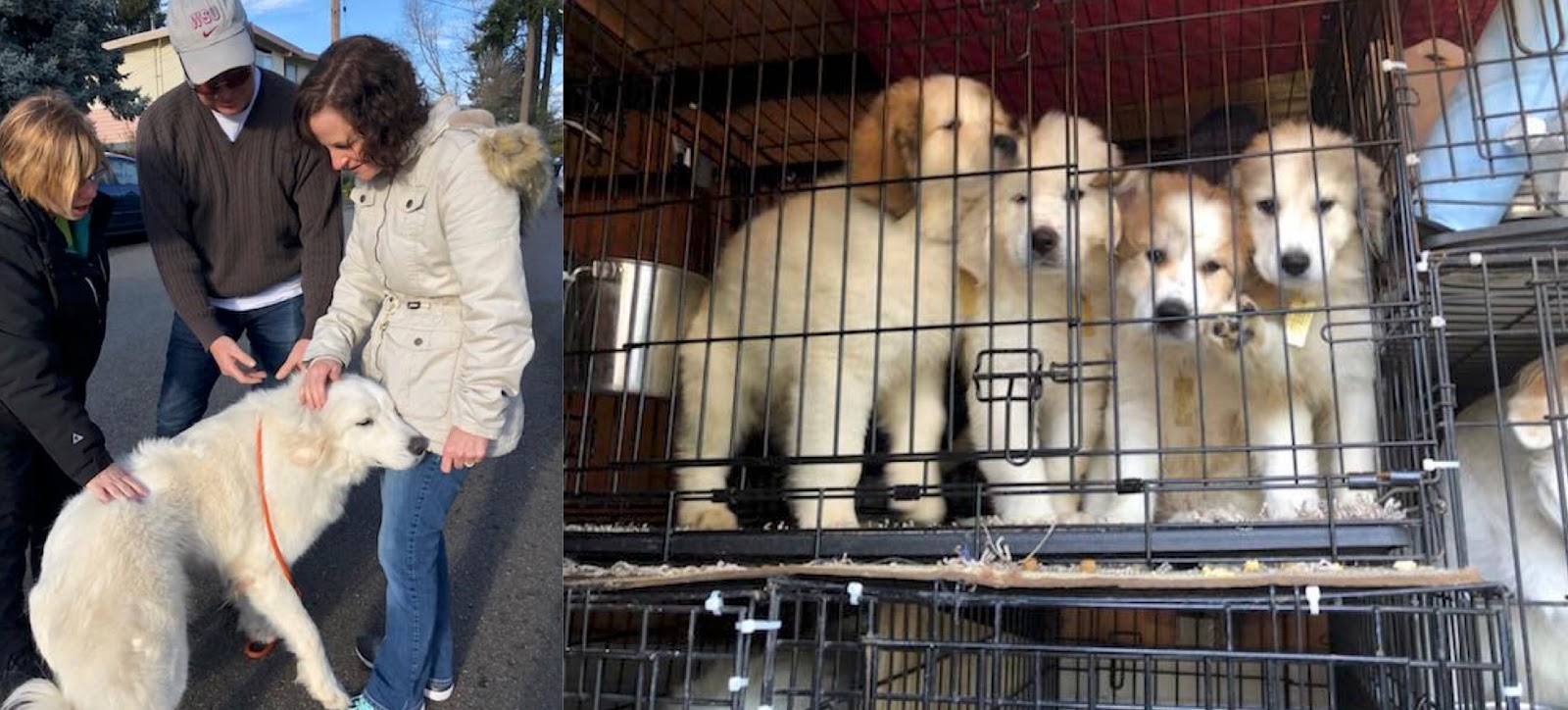
Well, the amazing Jeff Sweeney is about to embark on the first 2018 trip from Texas to Washington, dropping off Pyrs at strategic places along his way.  To the volunteers and families who are waiting for foster dogs or new family members, it is a very exciting time!  At the drop off locations Pyr lovers gather, some with leashes in hand, Pyrs and other dogs in their cars, and others with their human children.  For the volunteers it's a great opportunity to meet a dog we've heard about through Facebook or to get a quick hit of puppy breath.  It's extremely rewarding seeing a family meet their new family member in person for the first time and knowing the (sometimes wide-eyed Pyr) has a new loving home.

Jeff's route this trip
Most of our dogs come into rescue from kill shelters around the Central Texas, South Texas, and Greater Houston area.  We place them in foster homes in the Pacific NW and Texas while they are evaluated and rehabilitated until we find a permanent home for them.  We transport and adopt to Washington, Oregon, California, Nevada, Colorado, Arizona, and other states near the Pacific NW and Texas.

We are an all volunteer, not-for-profit, rescue group dedicated the the rescue, rehabilitation, and re-homing of Great Pyrenees whose lives are in danger.  Check back and we will see pictures from some of the drop off locations and the First Hugs from Transport!


Monday, January 8, 2018

Happy New Year!

Hello folks!

Sorry for the delay on posts.  While I've been away the rescue has had a number of wonderful adoptions to finish off the rest of 2017.  Here they are!

November adoptions:

We are marching fast towards the end of the year-and SANTA will  be here before we know it!!  We had a busy November, with all of our volunteers working hard to get 33 ADOPTIONS completed while enjoying our families and friends over the Thanksgiving holiday break!  Thank you SO MUCH to everyone for giving all of your positive energy and hard work to care for, foster and find wonderful homes for our sweet neglected Texas pyrs!

A big PYR PAW of congratulations goes out to: Paloma, Hunter, Henley, Pearl, Bree, Russo, Buddy, Baby, Lila Belle, George, Mya, Brazzy, Halo, Tyson, Hazel, Homer, Holden, Henry, Harper, Didi, Russell, Trigger, Tillie, Houston, Cotulla (S), Maude, Lizzie, Mikey (S), Zoe, Bonnie, Lenny, Zach, and Syrah (S).

Juliette

December adoptions:

HAPPY NEW YEAR!  And what an amazing year it has been!  We ended 2017 with 22 adoptions, which we did while also celebrating the Christmas holiday and taking winter vacations!  This is brought out 2017 adoption total to 431 adoptions in 2017!!!  To compare with previous years-we had 364 adoptions in 2016, and 325 adoptions in 2015- so we are saving more wonderful Great Pyrenees every year!  We could not do this without our AMAZING VOLUNTEERS that foster, screen applications, transport dogs, and help care for them in every way imaginable.  So THANK YOU ALL SO MUCH and have a blessed 2018-we hope to save many more next year!!

NOW a big PYR PAW of congratulations goes out to the following pyrs that found their forever home in December:  Clyde, Natalie, Skip, Renaissance, Kingston, Gemma, Bethany, Lottie, Justin, Hampton, Howie, Rondo Lark, Marni (S), Alan (S), Martin, Melody, Leo, Harvey, Stanley, and Alex (S)!

Juliette

If you would like to volunteer for the Great Pyrenees Rescue Society to help with adoptions in 2018 click on here and go to "How to Help".

If you don't have time to volunteer but would like to donate to help save these gentle giants, please donate here.

Let's make 2018 GREAT!